Consent management is no longer optional. Stricter privacy regulations, rising consumer expectations, and complex data ecosystems have necessitated the need for consent management. In fact, it has become one of the most pressing challenges for organizations today. Many businesses struggle with fragmented tools, inconsistent user experiences, and compliance risks that expose them to fines and reputational damage.
A consent management platform (CMP) helps automate the entire process for you. It displays a banner when someone visits your site, handles their preferences, blocks or allows cookies based on their choices, and keeps a record of all their actions.
Consent management platforms help your organization avoid the following pain points:
- Regulatory compliance complexity: CMPs help organizations comply with privacy regulations by managing consent collection, storage, and enforcement in a standardized way.
- Inconsistent user consent experiences: They provide consistent, branded consent interfaces across websites, apps, and regions.
- Difficulty honoring user rights and preferences: CMPs automate consent changes, withdrawals, and preference updates.
- Operational inefficiency and manual processes: They replace ad hoc or custom-built consent logic with scalable workflows.
- Third-party vendor and tracker management: CMPs control and document consent for cookies, SDKs, and third-party tools.
- Global and regional regulatory differences: CMPs adapt consent flows based on user location and apply the appropriate legal framework without requiring separate implementations.
In this guide, we will review the top consent management platforms available. Our goal is to make it easy for you to discover the solution that best addresses your pain points.
Our list of the best consent management platforms
Based on our independent research, defined selection criteria, and evaluation methodology, here are our top consent management platforms:
- Ketch EDITOR’S CHOICE TA flexible platform built to automate privacy compliance and consent at scale. Access a free trial.
- Usercentrics (FREE TRIAL) A consent management leader focused on optimizing user experience and compliance. Start a 14-day free trial.
- OneTrust A widely adopted solution that provides comprehensive privacy, risk, and compliance tools.
- TrustArc A veteran privacy platform providing end-to-end governance and consent solutions.
- Osano A lightweight, easy-to-deploy consent and data privacy management tool.
- Termly An affordable solution for small businesses to manage consent and compliance.
- CookieYes An affordable and relatively lightweight CMP with good features and multilingual support.
There are two particular types of activity that require businesses to seek consent from consumers. One is the storage of PII and the other is the use of cookies and tracking libraries on websites. Consent management platforms offer complete suites of functions to handle issues surrounding this field of activity.
If you need to know more, explore our vendor highlight section just below, or skip to our detailed vendor reviews.
Βest consent management platforms highlights

Top Feature
Real-time consent enforcement across analytics marketing and data systems
Price
Free for SMBs with simple cookie banners, paid plans start at $150 per month
Target Market
Mid-to-large organizations across regions needing automated real-time consent enforcement
Free Trial Length
Free trial available, duration not disclosed by the vendor
Additional Benefits:
- Reduces gaps from manual consent workarounds in complex data ecosystems
- Lets non-technical teams update consent experiences without engineering cycles
- Improves collaboration across legal, marketing and engineering teams
- Scales multi-region privacy programs with policy orchestration
Features:
- Creates banners and preference centers for websites apps and mobile devices
- Logs user choices centrally with audit-ready records
- Syncs consent status across analytics marketing and data systems
- Provides APIs and integrations for enterprise systems and data pipelines
- Automates DSAR workflows with data mapping and policy orchestration

Top Feature
Manages consent across web mobile and connected TV with ad-focused compliance control
Price
Starts at $8 per month
Target Market
Midsize to large organizations in regulated regions relying on advertising revenue
Free Trial Length
14-day free trial
Read more ▼

Top Feature
Enterprise consent engine that scans trackers and enforces preferences across channels
Price
Not publicly listed
Target Market
Global organizations with large data volumes and complex privacy compliance needs
Free Trial Length
Free trial available, duration not disclosed by the vendor
Read more ▼

Top Feature
Cookie Consent Manager with 100+ laws coverage and privacy signal support
Price
Pricing not publicly available
Target Market
Midsize and enterprise-level organizations
Free Trial Length
Free trial available, duration not disclosed by the vendor
Read more ▼

Top Feature
Consent management with AI cookie classification and no-fines guarantee up to $500k
Price
Not publicly listed on the official site
Target Market
Mid to large orgs managing high data volumes across multiple regions
Free Trial Length
Demo available upon request
Read more ▼

Top Feature
All in one consent platform built for SMB compliance basics
Price
Free option for basic use, Starter noted as $10 and also $14 per website monthly
Target Market
Small to mid-sized businesses, startups plus solo operators needing basic compliance
Free Trial Length
Free plan available
Read more ▼

Top Feature
One line setup with auto scanning plus script blocking before consent
Price
Starts at $10 per month per domain, free plan available
Target Market
SMBs, website owners plus e commerce shops needing global privacy compliance
Free Trial Length
14-day free trial, free plan available
Read more ▼
Here are the key factors you should keep in mind when choosing a consent management platform:
- Regulatory Compliance: Choose a tool that supports a wide range of privacy laws (like GDPR and CCPA) to help your business stay legally compliant across regions.
- Feature Depth and Flexibility: Give preference to tools with features such as consent management, granular control, and automatic cookie scanning to suit various business needs.
- Ease of Use and Integration: A tool that’s easy to set up and works well with your website, CMS, or analytics platform saves time and reduces technical headaches.
- Customization and Branding Control: You want a tool that makes it easy to customize your brand and build a consistent user experience and audience trust.
- Scalability for Teams and Enterprises: Consider tools that support your business growth and offer features such as user roles, multi-site support, and enterprise-level reporting.
- Market Reputation and Real-World Adoption: Tools with strong reviews and broad adoption are more likely to be reliable, well-supported, and continuously updated.
- Certified Google CMP Partner: Ensure the tools you choose meet Google’s Certified Consent Management Platform standards, which are crucial for compliance with Google services, such as AdSense.
To dive deeper into how we incorporate these into our research and review methodology, skip to our detailed methodology section.
CMP requirements
Although the US healthcare sector is very lucrative, the requirements of HIPAA, which is the US regulation on the management of Protected Health Information (PHI), don’t impact many businesses. The issue of cookie consent is much bigger.
Website creation tools make it easy for anyone to generate a site. However, these tools involve a lot of automation that relies on the use of pre-written libraries of functions. So, even if you create a website yourself, you probably won’t have any idea of what code went into it. Without realizing it, you have a site that uses cookies and if you don’t get consent for those, you could get into trouble.
If even the creator of a website doesn’t know what cookies and tracking libraries are used in the code, a business that commissions a new website from a Web development enterprise has even less chance of knowing what the site is doing behind the scenes. If you don’t know what cookies your site is downloading onto the computers of site visitors, you don’t know whether you have broken a law.
Consent legislation
The issue of user consent is not applicable everywhere in the world. However, websites are accessible from everywhere. So, if you just want to run a website without including consent management, your alternative strategy would be to block the site loading in the browsers of surfers located in several countries. That task is probably more complicated than deploying the services of a consent management platform.
The biggest legal requirement for PII management springs from the EU’s General Data Protection Regulation (GDPR). It is codified into the legislation of every EU member. There is also the ePrivacy Directive, which is an EU standard. In most EU countries, GDPR and ePrivacy legislation are bundled together. GDPR deals with the management and storage of PII and issues surrounding its movement. The ePrivacy Directive is really where the rules around cookie consent are formulated. However, as the same laws are implement both, consent management platforms refer to their cookie consent systems as being “GDPR compliant.”
The issues of PII and cookie management don’t stop at the EU’s frontier. California has the California Consumer Privacy Act (CCPA), which covers the use of PII, except for financial and health-related sectors, which are already covered by national PCI DSS and HIPAA rules.
CCPA doesn’t require businesses to gain consent for cookies. This legislation is focused on the use and sale of PII. However, websites have to inform visitors what data is going to be collected by its cookies and trackers and how that information is going to be used. If that data can be linked to a specific person or household, the storage and use of those records are covered by the act.
GDPR and CCPA are the two biggest headaches that a website owner has to worry about. However, the EU and California are not the only places in the world that has data and cookie consent requirements. Virginia’s Consumer Data Protection Act (CDPA), which comes into effect in 2023, covers the same requirements as CCPA.
Brazil’s Lei Geral de Proteção de Dados (LGPD) legislates on the management of PII but not cookies, unless they lead to the storage of PII. Canada has PIPEDA, which is the Personal Information Protection and Electronic Documents Act. Again, this covers PII and only relates to cookies in a PII context. South Africa’s Protection of Personal Information Act has been in force since 2020. POPIA is a very close copy of GDPR but not the ePrivacy Directive. This controls the use of PII and includes responsibilities for cookies and site trackers if they include the collection of PII in their functions.
Other countries around the world are currently formulating data privacy laws that will require consent management. These include India, Chile, and China.
Consent Management functions
Typically, a Consent Management Platform (CMP) will be integrated with other functions, such as data discovery and protection. However, strictly speaking, these protection measures are not part of consent management.
Consent management is specifically concerned with gaining approval from users for the storage of PII and consent for several different actions, such as transferring the data to other organizations or moving it outside of a particular location. For example, GDPR specifies that PII should not be moved out of the EU unless the person that information relates to gives consent.
The main task of a CMP is to identify which data types are subject to the ruling or, in the case of the ePrivacy Directive, which cookies and trackers are subject to legislation. In most cases, CMP will categorize cookies and trackers so that consent to their use can be sought in groups. Some sites include a very long list of cookies and trackers and listing them all would be off-putting to site visitors.
Once the presence of PII data stores or relevant cookies has been confirmed, the CMP should create an appropriate consent notification with options to allow the customer to accept or deny cookies. In the case of CCPA, the notification should inform the customer of data statuses and the individual’s rights.
All responses to consent requests should be recorded or, in the case of notifications, the fact that notification has been given should be noted. The consent database itself is subject to PII rulings and it has to identify each person in its records.
Cookie consent systems need to be able to block cookies and trackers from downloading if the site visitor does not give consent.
In the case of PII consent systems, the CMP needs to provide an avenue for users to enquire about the records held about them. This is called a Data Subject Access Request (DSAR). Users should also be allowed to request that their data is corrected if it is discovered to contain inaccuracies or even demand its removal. In the case of a removal of data, the business is within its rights to withdraw service from that user, should the retention of PII be a necessary element in the provision of that service.
The Best CMP Tools
The best consent management platform for you depends on the scope of your business. If you just want a cookie consent popup for your sites, you will have different requirements for businesses that run a targeted marketing tracking campaign or large corporations that have legal departments that want guidance on data privacy standards. A big difference in requirement spins around whether you hold PII or not.
In compiling this list, we looked for variations of services because not everyone needs all of the functions for consent management. For example, some businesses will need PII consent management, others won’t. Some businesses are looking for a full-service platform, others just want the bare minimum for as little money as possible. So, we put together a range of options.
1. Ketch (FREE TRIAL)
Best For: Mid-to-large organizations that work across regions and need automated, real-time consent enforcement.
Price: Free for SMBs with simple cookie banner requirements. Paid plans start at $150/month for the Starter tier.

Ketch is a data privacy and compliance platform founded in 2020. The platform provides a comprehensive consent management framework for data collection, storage, and enforcement processes. When deployed in your organization, you can use it to display clear consent banners and preference centers, capture and log user choices with audit-ready records, and automatically enforce those preferences across analytics, marketing, and data systems.
Ketch also provides tools for data mapping, automating subject rights requests (DSARs), and orchestrating policies across multiple regions with different regulatory requirements.
One of the things I love about Ketch is its intuitive user interface. Users with limited technical expertise will have no difficulty using it to manage their data privacy tasks.
Ketch recently introduced two major updates to enhance privacy management. First is the Ketch Switch, which helps businesses migrate from OneTrust to Ketch automatically without requiring a complete start from scratch. The second is Progressive Consent, which collects user permissions step by step as they use your site.
Ketch has carved out a niche in enforcing consent across complex data ecosystems. Its policy-as-code approach and real-time integrations can eliminate the gaps and manual workarounds that plague traditional CMPs.
However, using Ketch also means your privacy program will rely on its framework and update cycle. We recommend Ketch for mid-to-large organizations that handle personal data across multiple systems or regions. But if you only need basic consent collection and reporting, a simpler, cheaper CMP may be a better fit.
Ketch Key Features:
- Consent Collection: Customizable banners and preference centers for websites, apps, and mobile devices.
- Consent Storage: Centralized logging of user choices with audit-ready records.
- Consent Enforcement: Automatic syncing of consent status across analytics, marketing, and data systems.
- Regulation Support: Compliance with privacy laws, including GDPR, CCPA, LGPD, and regional-specific rules.
- APIs and Integrations: Connects consent workflows to enterprise systems and data pipelines.
- Cross-channel Coverage: Manages preferences consistently across web, mobile, and applications.
- Privacy Automation: Extends to data mapping, subject rights requests (DSARs), and policy orchestration.
- AI-Powered Data Discovery: Ketch helps you map and monitor where personal data is stored across your systems.
- Smart Consent Management: Consent preferences are automatically linked to your tags and trackers; only the right tools fire when permission is given.
Unique Buying Proposition
Ketch explicitly positions itself around “privacy as code” and consent orchestration, which differentiates it from most consent management platforms that focus only on banners and preference centers. Their documentation, product pages, and third-party reviews emphasize:
- Consent signals are programmatically enforced across all connected systems.
- The architecture is API-first, built to integrate with enterprise data pipelines rather than operate as a silo.
- Ketch frames consent as part of end-to-end privacy automation (data mapping, DSARs, policy enforcement) rather than a stand-alone CMP.
Their Privacy Experiences tool enables non-technical teams to set up consent banners and preference centers using a no-code interface. At the same time, automated background processes enforce the rules across all systems.
Feature-In-Focus: No-code, Modern Consent Management
Ketch’s no-code, modern consent management lets organizations create and update consent experiences without writing code, while enforcing user choices across systems in real time. This matters because privacy rules change often, and relying on engineers can slow compliance and increase risk. No-code consent management enables legal, privacy, and marketing teams to manage consent directly through an intuitive interface.
Why do we recommend Ketch?
We recommend Ketch because it is built for modern data operations where compliance, performance, and consumer trust all matter. Ketch facilitates collaboration between legal, marketing, and engineering teams through its no-code setup, cross-device identity matching, real-time tag orchestration, and a fast, lightweight system.
However, you will need to carefully configure and maintain the automation layer to ensure that rules remain accurate and aligned with changing regulations.
Who is Ketch recommended for?
Ketch is best suited for small, mid-sized, and large enterprises that manage user data across regions and platforms, such as e-commerce brands, SaaS platforms, fintech companies, and media companies with global audiences.
Pros:
- Free for small businesses: Offers a free tier suitable for organizations with basic cookie banner and consent needs.
- AI-powered data mapping and governance: Provides automated data discovery and governance capabilities that support broader privacy and data operations compliance.
- Lightweight, no-code customization: Enables quick setup and updates without requiring developer involvement.
- Cross-device and cross-channel identity stitching: Helps maintain consistent consent and identity management across devices and touchpoints.
Cons:
- Privacy knowledge required: May present a learning curve for users who are new to privacy concepts and regulatory requirements.
All Ketch price plans are cloud-hosted with CMP features included, and support varies by tier. Ketch’s consent management pricing starts with a free tier at $0 per month that supports CMP functionality for up to 5,000 unique visitors per month. The free option remains available as long as visitor limits are met, but exceeding those limits requires upgrading to a paid plan.
Paid plans begin with the Starter plan at $150 per month for up to 30,000 unique visitors, billed monthly, and scale to Plus (from about $333 per month, billed annually) for higher visitor limits and additional onboarding support. A Pro tier with custom pricing is available for larger enterprises and unlimited visitor counts. Try out the Starter edition by accessing a free trial.
EDITOR'S CHOICE
Ketch is our top pick for a consent management platform because it combines clear consent banners and preference centers with centralized, audit-ready consent records and automatic enforcement across analytics, marketing, and data systems. Its privacy-as-code positioning, API-first integrations, and cross-channel preference handling make it a strong fit for organizations operating across regions and complex data ecosystems. It also extends beyond CMP basics with data mapping, DSAR automation, and policy orchestration, and adds practical updates like Ketch Switch for migrating from OneTrust and Progressive Consent for collecting permissions step by step. If you only need basic consent collection and reporting, a simpler CMP may be a better fit
Download: Access teh FREE Trial
Official Site: https://app.ketch.com/sign-up
OS: Cloud-based
2. Usercentrics (FREE TRIAL)
Best For: Midsize to large organizations that operate in regulated regions and depend heavily on advertising revenue.
Price: Starting at $8 per month.

Usercentrics CookieBot is a global market leader in cookie consent management, data compliance, and preference management. It was founded in Germany with offices in Denmark, Portugal, the Czech Republic, and Argentina. Due to its European roots, it is no surprise that its features are designed around EU privacy standards and closely aligned with the GDPR requirements.
Think of Usercentrics as your front-end privacy infrastructure. The company enables businesses to collect, manage, and document user consents, and also helps you prove it when it matters. Usercentrics’ consent management covers web, mobile, and connected TV. In 2021, Usercentrics strengthened its market position by acquiring Cookiebot. This acquisition resulted in a broader portfolio of solutions that caters to large and small organizations.
Usercentrics Key Features:
- Consent Banner Customization: Usercentrics enables you to fully customize banners to match your brand and avoid a generic appearance.
- Automatic Cookie Categorization: It auto-detects and classifies cookies (analytics, ads, essential, etc.) with an enterprise-level engine.
- Tag & Script Control: It works with tools such as Google Tag Manager to block or release tags based on user consent.
- Multilingual & Multi-Region Support: Supports over 40 languages, which makes it ideal for global teams managing compliance across multiple regions.
- API Access: Integrate consent data with other systems and platforms through API access.
- Server-Side Consent Storage: Store consent data securely on the server side to enhance data protection and compliance.
Unique Buying Proposition
Usercentrics’ unique buying proposition is its deep alignment with the advertising ecosystem. The platform also provides strong support for the IAB TCF 2.2 framework. Companies that rely on data-driven advertising can remain compliant with privacy regulations while still enabling effective ad targeting and measurement.
Feature-In Focus: Automated global compliance with integrated consent enforcement
Usercentrics automatically detects cookies and trackers, blocks non-essential services until valid consent is obtained, and ensures consent signals are enforced across systems and third-party tools.
This feature ensures organizations automatically comply with the relevant privacy laws and collect data only when users have given valid consent. It reduces manual effort, lowers compliance risk, and allows marketing and analytics tools to function correctly while respecting user choices.
Why do we recommend Usercentrics?
We recommend Usercentrics due to its maturity, flexibility, and consistently delivered enterprise capabilities. We found its consent banners, preference centers, and tag control to be highly customizable.
Most of the CMPs we tested also support customization; however, the difference is that Usercentrics’ customization is more granular in both design and integration. Companies that want brand consistency or fine control over user interactions will find this feature beneficial.
Furthermore, our findings suggest that Usercentrics works well for both regional and global organizations. Its support for 40+ languages and multi-region compliance features eliminate the need for separate tools across markets.
Who is Usercentrics recommended for?
Usercentrics is best suited for organizations that operate in regulated regions, rely heavily on advertising revenue, and want to ensure privacy does not become a barrier to growth.
We recommend it for midsize to large organizations with a global user base, tag-heavy websites, and internal compliance or legal teams.
Pros:
- Advanced customization and compliance logic: Offers robust rule-setting and localization capabilities to meet complex regulatory requirements across regions.
- Seamless mar tech integrations: Integrates smoothly with major analytics, advertising, and marketing platforms to ensure consent signals are enforced end-to-end.
- Strong GDPR foundation: Built with deep European regulatory expertise, ensuring high alignment with GDPR standards and expectations.
Cons:
- Developer involvement during setup: Initial configuration and advanced customizations may require engineering resources.
- Less flexible no-code UI: The interface can feel more structured and less intuitive compared to newer, fully no-code CMPs like Ketch.
Usercentrics is cloud-hosted (no on-prem self-hosted option listed), supports web, app, and other CMP deployments with variable plan scope, and requires upgrading to retain consent collection and full compliance after the trial ends.
It offers a 14-day free trial with no credit card required. After the trial, paid Web CMP plans start at $8 per month for the Essential tier and scale up to €50 per month for the Business tier, with a Corporate tier available at custom pricing for high-traffic or enterprise use. All core paid plans are billed monthly and include session and domain limits that increase with price. A free plan option exists in some integrations, but the main Usercentrics Web CMP free trial is time-limited rather than a perpetual free tier.
3. OneTrust
Best For: Global organizations that handle lots of user data, face complex privacy laws, and need strong compliance tools.
Price: Not listed publicly.

OneTrust is a leading provider of privacy and security software solutions, founded in the United States in 2016. OneTrust Consent Management is an enterprise-level privacy engine that helps organizations collect, store, and enforce user consent in accordance with laws such as the GDPR and CCPA.
It offers banners, pop-ups, and preference centers, logs user choices for audits, and integrates with marketing and analytics tools to apply preferences. It operates globally and is well-known for its innovative Trust Intelligence Platform.
OneTrust recently updated its cookie consent tools to improve security and usability. The changes include the web scanner IP address, default two-factor authentication for all accounts, and an enhanced UI. These changes were introduced to address cookie and tracker scanning issues that occur after infrastructure upgrades.
OneTrust has established itself as one of the most recognized names in consent management, primarily due to its global reach and comprehensive compliance coverage. It features a mature, highly scalable platform trusted by enterprises.
However, the cost, learning curve, and numerous features may feel excessive if your primary goal is to manage simple consent banners. In that case, a simpler and more cost-effective CMP may be a better fit.
OneTrust Key Features:
- Advanced Website Scanning: It identifies first- and third-party trackers, including hidden or behind-login cookies, and maintains a dynamic inventory to ensure full compliance.
- Cookie Auto-Blocking: Block non-essential cookies until explicit user consent is granted using no-code tools or tag manager/script integration.
- Omnichannel Consent Management: Extend the consent framework to mobile apps, OTT (Over-The-Top) platforms, and Connected TVs (CTV) to cover all user touchpoints.
- Consent Optimization Tools: A/B testing capabilities help you improve opt-in rates, while consent sync across devices ensures a consistent experience for users.
- Compliance Automation: Schedule scans, auto populate cookie disclosures, and generate audit logs with detailed user consent records to ensure you’re always inspection-ready.
Unique Buying Proposition
The unique selling point of OneTrust is its Trust Intelligence Platform, which unifies privacy, security, ethics, and ESG into one system.
Most organizations today operate under intense regulatory scrutiny, rising consumer expectations, and increasing pressure from investors and stakeholders. Handling privacy, security, ethics, and ESG (Environmental, Social, and Governance) as separate checklists often leads to gaps, duplication, and reactive firefighting when problems arise.
The OneTrust Trust Intelligence Platform enables organizations to embed trust into their data governance, risk management, and accountability across the business. This integrated approach elevates OneTrust from a consent management provider to a broader enterprise risk and trust management solution.
Feature-In-Focus: Consent capture and enforcement across digital channels
OneTrust emphasizes advanced scanning and categorization of cookies, SDKs, and third‑party trackers with an evergreen inventory. This feature enables organizations to collect and manage user consent in a compliant way, and also demonstrate and enforce those preferences consistently across systems. It also provides geolocation‑aware, multilingual consent banners and preference centers that block trackers until consent is given.
Why do we recommend OneTrust?
OneTrust is highly recommended as a consent management platform due to its maturity, global compliance coverage, established reputation, and widespread market trust. It is one of the most widely adopted CMPs and comes with an extensive library of pre-built templates and workflows.
The platform can handle large volumes of data and user interactions without compromising performance. Its strong audit and reporting capabilities make it easier for compliance teams to prove adherence during regulatory reviews. These qualities, among others, make OneTrust a reliable choice for organizations that require a proven, enterprise-grade CMP.
Who is OneTrust recommended for?
OneTrust is best suited for enterprises and mid-market organizations with complex global footprints.
If you are a small business with basic cookie needs, OneTrust may feel like overkill. In that case, lighter platforms like Ketch or Termly might be more cost-effective.
Pros:
- Mature, scalable, and highly configurable: Offers a robust platform that can handle large volumes of users and complex compliance requirements.
- Multi-channel consent coverage: Supports consent management across web, mobile, OTT, and CTV platforms in a single solution.
- Built-in optimization tools: Provides analytics and features to improve user opt-in rates.
- Strong automation and reporting: Includes automated workflows, detailed reporting, and audit support for regulatory compliance.
Cons:
- Steeper learning curve: New users may require time to fully understand and utilize all platform features.
- Opaque, quote-based pricing: Costs are not publicly listed and require contacting sales for a custom quote.
- Overwhelming for simple needs: Organizations with basic consent requirements may find the platform more complex than necessary.
OneTrust pricing is custom‑quoted based on usage metrics such as average daily visitors, data subject counts, or inventory size. You must contact OneTrust for a tailored quote. Actual pricing is usually influenced by scope, usage, and enterprise needs. Billing terms (monthly vs. annual) are negotiated with OneTrust and often reflect annual commitments.
There is no standard perpetual free tier, but OneTrust offers free trials on select solutions, though availability and length vary and typically require engagement with sales. Support levels and features vary by contract and modules purchased.
4. TrustArc
Best For: Midsize to enterprise-level organizations.
Price: Not publicly available.
TrustArc is a privacy compliance technology company founded in the United States in 1997. Usercentrics traces its roots back to the non-profit TRUSTe and, in 2008, transitioned into a venture-backed for-profit company.
TrustArc was among the first organizations to push for stronger self-regulatory standards and online consumer data protection. Its roots trace back to the Electronic Frontier Foundation (EFF) and the early days of internet privacy advocacy. That history matters, especially when many consent platforms today focus only on meeting regulatory requirements without a solid privacy philosophy.
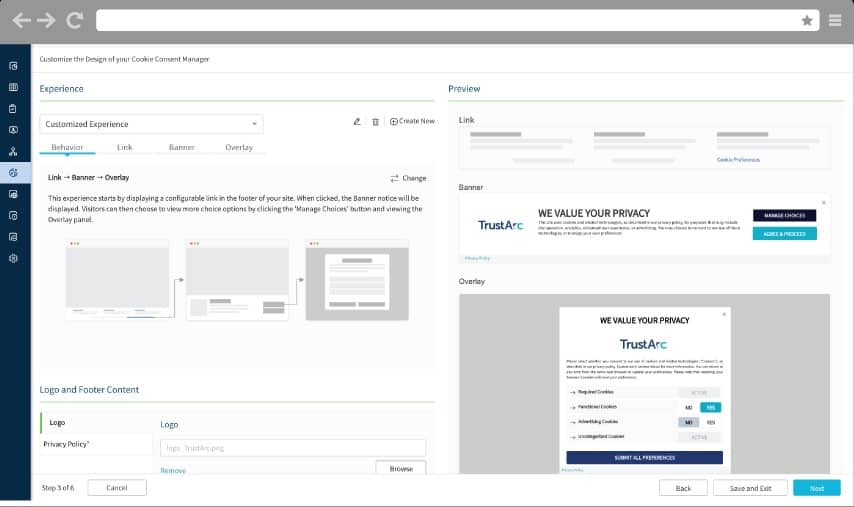
TrustArc’s Cookie Consent Manager is a comprehensive compliance system designed to help organizations navigate the challenges of evolving regulations without compromising user experience or risking fines. Our research shows that TrustArc maintains audit-ready consent records, supports privacy signals such as GPC, and adheres to standards like IAB TCF 2.2 and Google Consent Mode.
In a nutshell, TrustArc has established itself as one of the most prominent names in consent management. However, its broad feature set can be more than smaller organizations actually need, and the platform may feel heavier compared to leaner tools like Osano or Termly.
TrustArc Key Features:
- Global Consent Coverage: Built-in support for 100+ privacy laws, including GDPR, CCPA, PIPEDA, Quebec’s Law 25, and Colorado’s CPA.
- Automated Tracker Management: Scans your site, detects trackers (even those behind logins), and automatically categorizes them to reduce manual work.
- Cross-Device and Cross-Domain Consent: Syncs user choices across web, mobile, and multiple domains.
- Fast, Easy Setup: One script for all sites and apps, plus a 4-step setup wizard—no coding needed.
- Privacy Signal Support: Honors GPC and Do Not Track, and works with IAB TCF 2.2, IAB CCPA, and Google Consent Mode.
- Transparent Disclosures: Shows users which trackers are running, why, and how their data is handled.
- Real-Time Dashboards: Tracks opt-in rates, bounce rates, and device data for better UX decisions.
Unique Buying Proposition
TrustArc’s unique buying proposition is its longstanding legacy in data and privacy protection, which gives it a level of legal credibility and thought leadership that most CMPs lack. TrustArc brings decades of expertise shaped by its history with the Electronic Frontier Foundation and early internet privacy advocacy.
Feature-In-Focus: Privacy-first, globally compliant cookie consent management
TrustArc’s main CMP feature is its privacy-first, globally compliant cookie consent management. This means the company values user privacy and respects consent choices across devices, browsers, and countries.
This feature empowers organizations to safely collect, enforce, and synchronize user consent across multiple devices, browsers, and international domains. It also improves user experience with clear, consistent consent, thereby boosting engagement and conversions.
Why do we recommend TrustArc?
TrustArc earns our recommendation as a top CMP due to its global coverage, ease of deployment, strong technical execution, and practical usability.
TrustArc backs up its reputation with features that show it can handle both global compliance and complex sites. It supports over 100 privacy laws worldwide, including the GDPR, CCPA, Quebec’s Law 25, and more. It is also built for easy rollout. We were able to deploy it using just one script and a simple 4-step wizard.
And if your business already deploys other TrustArc products such as Data Mapping or Risk Assessments, staying within the ecosystem simplifies things.
Who is TrustArc recommended for?
TrustArc is suitable for mid-sized to enterprise-level organizations, companies with multi-domain or multi-region presence, and legal and privacy teams that require granular control.
Pros:
- Privacy-first approach: Built with a focus on user privacy rather than just meeting compliance checkboxes.
- Industry credibility: Long Standing recognition and deep roots in privacy advocacy provide strong trust and reliability.
- Easy setup and dashboards: Offers straightforward implementation and real-time dashboards for monitoring consent.
Cons:
- Learning curve for non-privacy professionals: Users unfamiliar with privacy concepts may need time to adapt.
- Dated user interface: The UI can feel less modern compared to newer CMPs.
- Opaque pricing: Costs are not publicly listed and require contacting sales for a quote.
TrustArc’s pricing is typically custom‑quoted. Actual costs vary based on scope, domains, and compliance needs. There is no permanent free tier, but TrustArc offers a free trial or proof‑of‑concept period upon request. The solution is delivered as cloud‑hosted software that covers global cookie consent and broader privacy management.
Support and feature scope are tailored to the purchased modules and service agreement. Paid engagements are generally structured around annual subscriptions negotiated with TrustArc’s sales team.
5. Osano
Best For: Mid-to-large organizations handling large volumes of data across multiple regions.
Price: Not publicly listed on its official website

Osano is an all-in-one data privacy platform founded in October 2018. Osano’s CMP helps websites and apps collect, store, and enforce user consent for data-processing activities (cookies, trackers, preference selections, etc.). It offers tools for unified consent & preference management across multiple laws/regions. Key components include a consent banner/preference center, script/tag blocking, audit logs, multilingual/regional compliance, dashboards & reporting.
Beyond consent, Osano can automatically map and classify your data, manage vendor risks, and safeguard customer information across your ecosystem. It works well with major privacy frameworks. Examples include Google Consent Mode v2, IAB TCF 2.x, and regional laws, to ensure compliance across all markets.
In a nutshell, Osano positions itself around simplicity and trust. Its strongest appeal is in quick deployment, AI-powered cookie classification, and global legal coverage. However, Osano may not offer as much customization and automation as you would find in some other platforms. So if you need highly customized workflows, Ketch or OneTrust may be a better fit for you.
Osano Key Features:
- Guaranteed Compliance: Osano backs its platform with a “No Fines, No Penalties” guarantee up to $500,000.
- One-Line Install, Minutes to Launch: Paste a single JavaScript snippet into your site’s header and be up and running within minutes.
- Auto Cookie Classification with AI: Osano automatically scans your website, identifies cookies, and suggests classifications for them.
- Banners Built to Be Seen (Not Blocked): Osano enables you to preview how banners will appear in different regions and devices.
- Real-Time Dashboards & Consent Logs: Osano maintains detailed consent logs, provides granular user controls, and features powerful dashboards that highlight compliance risks before they become issues.
Unique Buying Proposition
Osano’s unique strengths include its “No Fines, No Penalties” guarantee of up to $500k, AI-powered cookie and script classification to save time, a unified dashboard for managing user consents across devices and regions. It also offers fast setup with global coverage for over 95 privacy laws in more than 50 countries.
Although some CMPs offer some of these features, Osano’s combination makes it relatively rare. The “No Fines, No Penalties” guarantee is quite rare. Few CMPs make a promise to cover fines under specified conditions. Osano’s AI classification appears more aggressive in coverage, with a confidence-score mechanism to help you prioritize.
Feature-In-Focus: Simplicity-first, compliance-guaranteed consent management
Osano’s feature in focus as a CMP is its simplicity-first, compliance-guaranteed consent management. The platform emphasizes easy, fast deployment and built-in legal and privacy expertise. It also offers a unique “No Fines, No Penalties” guarantee that reduces compliance anxiety for customers.
Why do we recommend Osano?
We recommend Osano as a top CMP due to its ease of use and wide coverage. It offers a one-line install, discovery mode, and simple dashboards that reduce the need for constant developer support.
It also covers over 95 privacy laws in 50 countries and includes tools such as DSAR automation, vendor risk management, and data mapping.
Who is Osano recommended for?
Osano is best suited for mid-to-large organizations handling large volumes of data across multiple domains or regions.
However, Osano may not be ideal for small businesses with simple needs and tight budgets, as its advanced features are more cost-effective at scale.
Pros:
- No-Fines Compliance Guarantee: Provides contractual assurance around regulatory compliance, reducing financial risk.
- Built-in legal and privacy intelligence: Combines technology with embedded legal expertise, not just technical enforcement.
- Fast, low-effort setup: Enables rapid deployment with minimal developer involvement.
- Access to privacy experts: Includes direct support from privacy professionals for guidance and best practices.
Cons:
- Limited edge-case flexibility: Strong compliance guardrails can restrict highly customized or unconventional setups.
- Advanced features gated by plan: Capabilities such as multi-site dashboarding are available only on higher-tier plans.
In terms of pricing information, Osano no longer lists full pricing details publicly on its official website. It has now shifted to a demo‑first, sales‑led approach. Therefore, you’d need to contact Osano sales and describe your use case. Include details such as the number of domains, daily traffic, regions of operation, expected growth, and which modules you need, such as CMP, DSAR management, or unified consent. Ask specifically for a detailed price breakdown and billing terms (monthly vs. annual).
Pricing for consent management is usage‑based on traffic (measured by daily script loads). It is typically billed via subscription with terms agreed in the contract rather than fully published online.
6. Termly
Best For: Small to mid-sized businesses.
Price: Free for minimal compliance. $10 for the Starter plan.

Termly initially began by providing businesses with an easy-to-use policy generation tool to meet data regulatory requirements. It has since expanded into an all-in-one consent management for SMBs around the globe.
Termly consent management solutions include the following: Cookie Scanner, Cookie Banner, Cookie Policy Generator, and Cookie Consent. These tools simplify cookie management and keep your organization compliant with global privacy laws.
If you are a smaller business, startup, or solo operator looking to cover all the legal basics without hiring a lawyer or IT team, Termly is a wise choice. It gives you one platform to manage privacy policies, cookie banners, return policies, and more.
Notwithstanding, it does not offer the advanced customization or big-enterprise features you’d get from bigger brands. And that’s the idea. It is designed to be simple, affordable, and focused on covering the basics effectively.
Termly Key Features:
- Automated cookie scanning and categorization: Termly scans your website for trackers and cookies and blocks them based on visitors’ consent preferences.
- Customizable cookie banner & preference center: Match your brand’s look and feel while staying compliant.
- Automatic cookie policy generation: No need to write your own. Once cookies are detected, Termly automatically generates and updates your policy.
- Consent logging & DSAR forms: You get built-in tools to handle data subject requests and maintain proper records for regulators.
- Easy setup: One HTML snippet gets you up and running quickly, and you can manage everything from one clean dashboard.
Unique Buying Proposition
What sets Termly apart is its simplicity and automation. The platform is built for business owners who need to get compliant fast without the stress. It’s lightweight, easy to install, and quietly handles privacy compliance in the background.
Feature-In-Focus: Automated, All-in-one Compliance Management
Termly’s feature in focus is its automated, all-in-one compliance management for websites and apps. This feature helps you keep your policies and consent tools automatically up to date and makes installation simple with minimal technical work. It also supports your business across multiple platforms and saves you money on legal fees with ready-made, attorney-approved policies.
Why do we recommend Termly?
Termly earns our recommendation as a convenient option for organizations without an in-house legal team. The platform automates many of the most tedious compliance tasks, including cookie categorization, policy updates, and log maintenance.
Who is Termly recommended for?
Termly is best for small to mid-sized businesses, e-commerce stores, and website owners who need a quick, affordable way to comply with global privacy laws. It is easy to install, automates much of the consent process, and does not require the services of developers or legal consultants.
Pros:
- Intuitive and easy to install: Quick setup with a user-friendly interface.
- Fully automated cookie scanning and policy updates: Keep compliance up to date with minimal manual effort.
- Custom styling for branding consistency: Ensures consent banners and interfaces align with the company branding.
- Multi-jurisdictional compliance: Covers multiple privacy laws and regions.
- Free version available: Provides solid features for smaller websites or basic needs.
- Helpful customer support and legal resources: Access to guidance and resources for privacy compliance.
Cons:
- Limited enterprise customization: Not as flexible or robust as enterprise-grade CMPs.
- Scalability constraints for high traffic: Heavy-traffic websites may need to upgrade to a paid plan.
- Policy and script limitations for advanced users: May restrict highly customized workflows or technical implementations.
Regarding pricing, Termly offers a free plan that provides access to basic compliance tools, including a cookie policy and consent banner, supporting up to 10,000 banner views per month. Paid plans start at $14 per website per month for the Starter plan (billed monthly) and go up to $20 per website per month for the Pro+ plan.
Both plans include enhanced features such as more banner views, regular cookie scans, and additional customization, with annual billing available at discounted rates. There is also an Agency plan with custom pricing for managing multiple sites or resellers.
7. CookieYes
Best For: SMBs, website owners, and e-commerce shops that need to comply with global privacy laws but don’t have big legal or technical teams.
Price: Starts at $10/month /domain for small businesses and startups
CookieYes is an all-in-one cookie consent management platform founded in 2018. It was originally launched as a WordPress plugin to make GDPR compliance simple for developers and website owners. Today, it supports millions of websites worldwide by providing easy-to-use tools for data privacy compliance.
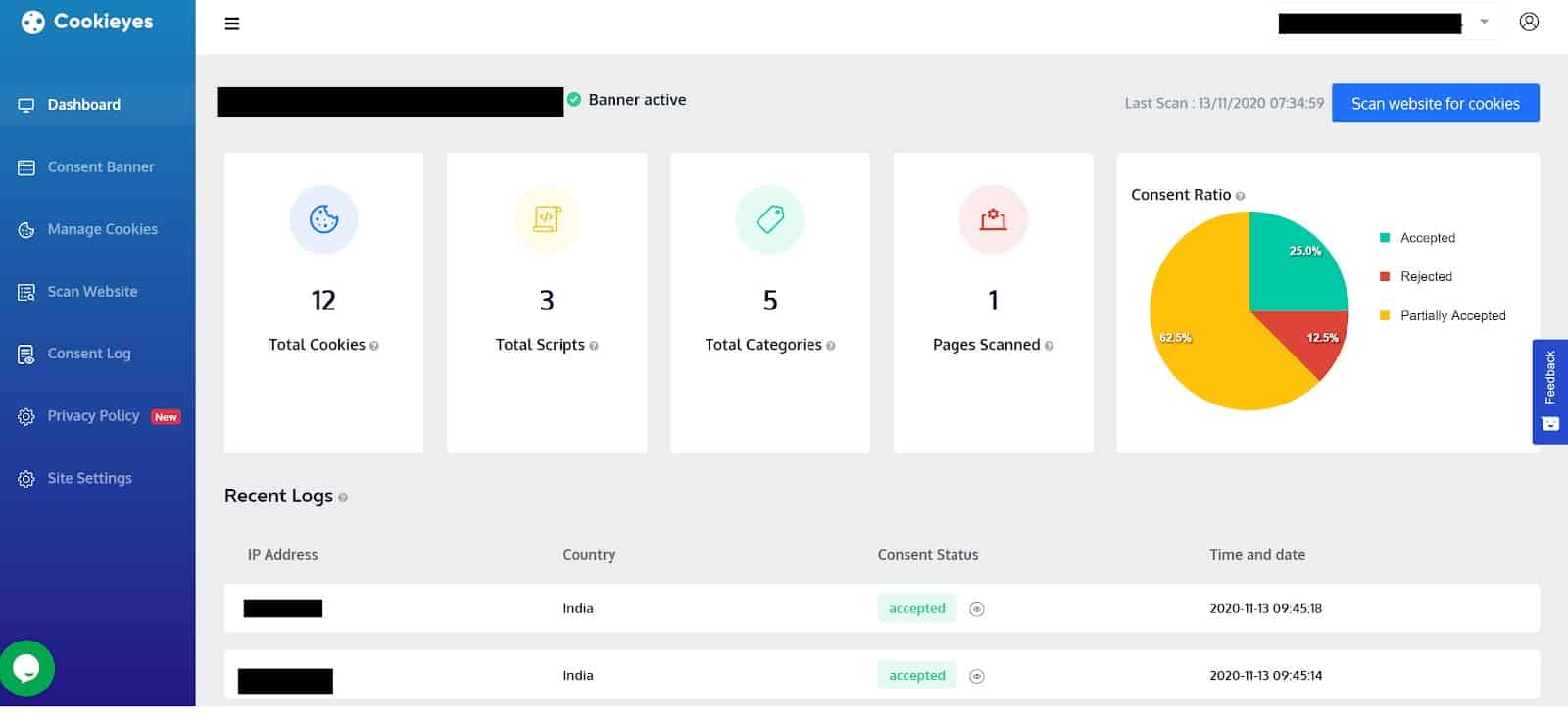
CookieYes scans your website to detect and categorize cookies, then manages them through customizable consent banners and preference centers. It automatically blocks non-essential scripts until users provide consent and maintains detailed consent logs for compliance purposes.
CookieYes is a good option for SMBs that want an easy, affordable way to manage cookie consent and comply with global privacy laws. Compared to Termly, CookieYes focuses on simplicity and fast setup. In short, choose CookieYes if you want a simple, quick, and budget-friendly solution.
CookieYes Key Features:
- One-Line Installation: Easily deploy a customizable cookie consent banner by adding a single line of code to your website.
- Automated Cookie Scanning: Regularly scans your website to detect and categorize cookies, and ensure up-to-date compliance.
- Consent Management: Provides tools for obtaining and managing user consent, including opt-in/opt-out options and preference centers.
- Script Blocking: Automatically blocks non-essential third-party scripts until user consent is obtained.
- Integrations: Supports industry standards like Google Consent Mode v2 and IAB TCF v2.2, and integrates with popular CMS platforms such as WordPress, Shopify, and Wix.
- Legal Policy Generators: Offers tools to generate cookie and privacy policies based on your website’s scan results.
Unique Buying Proposition
CookieYes’ unique advantage is its ability to tailor its features for small businesses and non-technical users. CookieYes focuses on speed, simplicity, and affordability. You can deploy a cookie banner in minutes by adding just one line of code to your site.
CookieYes itself documents and promotes this as a core feature. Their setup process requires you to paste one script tag into your website’s header, after which the platform automatically scans, blocks, and categorizes cookies.
Feature-In-Focus: Automated, End-to-end Cookie Consent Management
Termly’s feature in focus is its automated, end-to-end cookie consent management, which handles the entire consent process for you. It scans and organizes all cookies and trackers on your website, blocks third-party scripts such as Google Analytics and Facebook Pixel until visitors provide consent, and keeps detailed records of that consent.
You can customize consent banners to match your branding, display them in multiple languages, and Termly automatically updates policies as privacy laws or your site content change, ensuring seamless compliance with minimal effort.
Why do we recommend CookieYes?
CookieYes caught our attention due to its simplicity, speed, affordability, and reliable compliance coverage.
It earns its place through features that solve the most common pain points: automated cookie scanning and blocking, customizable consent banners, centralized consent logs, and ready-made integrations with Google Consent Mode v2, IAB TCF v2.2, and major CMS platforms (WordPress, Shopify, and Wix).
Who is CookieYes recommended for?
CookieYes is primarily targeted at small to mid-sized businesses, website owners, and e-commerce operators who need to comply with global privacy laws but lack large legal or technical teams.
Pros:
- User-friendly for non-technical users: The platform is suitable for users with little or no technical expertise.
- Global compliance support: Helps ensure compliance with various privacy regulations, including GDPR, CCPA, and LGPD.
- Customizable consent banners: Allows you to match banners to your website’s design and branding.
Cons:
- Advanced features require higher-tier plans: Certain functionalities, such as removing branding or accessing advanced options, may only be available on upgraded plans.
CookieYes offers a free plan for blogs and personal websites at $0 per month per domain. The plans are billed monthly (with the option to choose annual billing at a reduced rate in some cases). Paid plans support cookie scanning, compliance automation, and script integrations; domain usage and feature access scale with your chosen plan.
Paid plans are available on a cloud‑hosted, SaaS basis and start at about $10 per month per domain for the Basic plan. The Pro plan starts at $25 per month, and the Ultimate plan starts at $55 per month. Each paid plan includes a 14‑day free trial.
Our methodology for choosing consent management platforms
We followed a structured process to identify consent management platforms. Our evaluation focused on the following factors:
1. Global regulatory coverage
We assessed how well each CMP supports compliance with privacy laws worldwide, including the GDPR, CCPA, LGPD, and other emerging regulations.
2. Feature depth and flexibility
We evaluated the range and adaptability of features each tool offers, including automated consent management, cookie scanning, consent logging, and policy updates.
3. Ease of use and integration
Tools were judged on how simple they are to set up, navigate, and integrate with websites, apps, and marketing platforms.
4. Customization and branding options
We considered whether CMPs allow personalized banners, consent flows, and styling to match a company’s brand identity.
5. Scalability
Platforms were reviewed for suitability across different business sizes, from small teams to large enterprises handling high traffic and multiple domains.
6. Market reputation and real-world adoption
We considered industry recognition, customer reviews, and proven use by other organizations.
7. Google CMP certification
All CMPs reviewed are certified Google CMP partners, meaning they are approved to work seamlessly with Google Consent Mode and ad platforms.
Broader B2B Software Selection Methodology
We evaluate B2B software using a consistent, objective framework that focuses on how well a product solves meaningful business problems at a justified cost. This includes assessing overall performance, scalability, stability, and user experience quality. We examine real-world feedback from practitioners to understand how the software behaves in non-controlled demos.
We also review vendor transparency, roadmap clarity, support responsiveness, and the pace at which meaningful improvements are released. We follow this approach to ensure each of our recommendations is grounded in practical value, long-term viability, and operational impact, not in marketing claims.
Check out our detailed B2B software methodology page to learn more.
Why Trust Us?
Our work is produced by a team of IT and business software professionals with extensive hands-on experience evaluating, deploying, and managing enterprise technology. We analyze software independently, using evidence-based methods and industry best practices to ensure our assessments remain unbiased and technically sound.
Our goal is to provide you with clear, reliable insights that help reduce risk, shorten evaluation cycles, and support confident decision-making when selecting complex business technology.